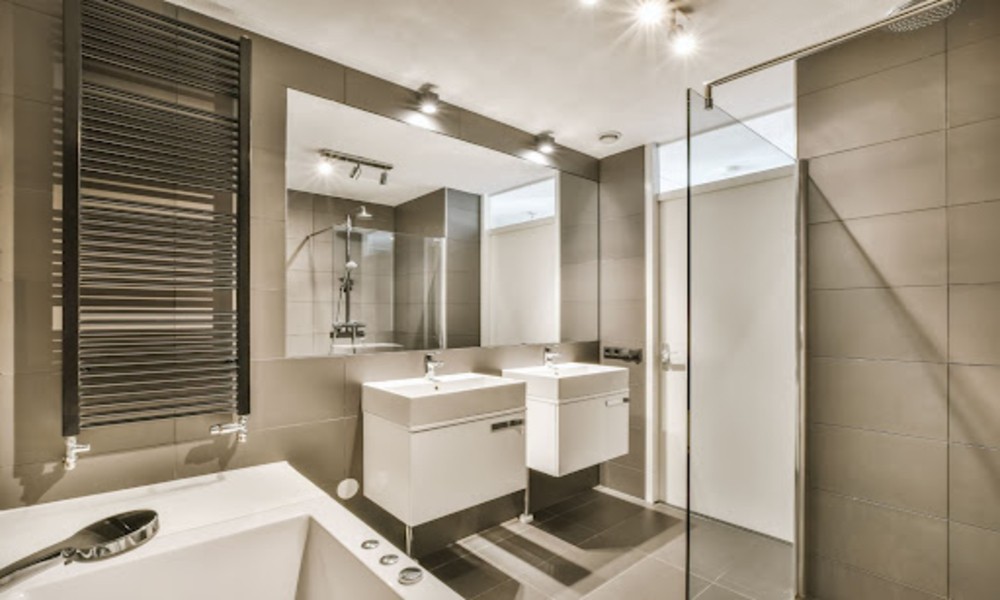


Designing a small bathroom might seem like you don’t have enough options, but with careful planning and clever choices, a tiny space can still feel airy, functional, and sophisticated. We, at our studio, never let the size of the space limit our creativity to comfort or beauty. Over the years of our experience in interior design for bathrooms, we have come to know that small, purposeful design moves have the power to not only change the look of the tightly constrained layout but also make them appear as spacious and luxurious as one would expect.
Small bathrooms don’t have to sacrifice style or comfort to feel roomy. This guide is a deep dive into the ingenious design tactics that widen small bathrooms metaphorically and keep them practical for daily routines. Optics, storage, and lighting are some of the ideas included here, and they are all based on proven and tested design principles that are implementable in any household.
Start with a Light, Thoughtful Color Strategy
Color is the factor that most rapidly changes the appearance of a room. Darker colors in small bathrooms tend to diminish the space in pictures, whereas lighter colors attract light and promote the sense of free space. Soft whites, light greys, warm beiges, and pastel colors are perfect starting colors. They do not let light pools form in the middle of the room and visually extend the walls.
Theoretically, the area does not have to lose its character and freshness. Throws, matte finishes, and even color variations can bring the feeling of volume without crowding the space. As an example, light tiles on the walls and somewhat darker tiles on the floor can help to keep the room both balanced and spacious.
Harmony in colors between paint, tiles, and fixtures also helps to clear visual space and gives the feeling of a small bathroom without walls.
Let Mirrors Do the Heavy Lifting
In general, mirrors might be the most decisive elements in small bathrooms’ design. A carefully positioned mirror can make a room look twice the size and also double the amount of light (both natural and sourced). Large wall mirrors, rather than small, framed ones, are more suitable for confined spaces. They remove interruptions in the view and produce a crystal-clear image that confuses the brain into perceiving the reflection as a continuation of the room.
In very limited spaces, mirrors facing the source of light (window or lamp) reflect the light coming from there and thus increase the room’s brightness. At the same time, mirrored cabinets are a perfect solution to the problem that provides neat storage without taking up additional space.
When used effectively, mirrors transcend their practical role and become a major design feature.
Smart Layout Planning Comes Before Style
The beauty of the materials and colors cannot save the poorly thought-out layout, making a small bathroom instantly cramped with no space for movement. The wise utilization of space mainly deals with the path people will take, the distance between the fixtures, and unobstructed views. What layout designers aim at is to leave the central area free of any structures and to line the walls with cabinets and other units of utilities that will make the most of the small space.
To achieve this aim, wall-hung WCs and floating vanities are great, as they not only allow better use of the floor space but also provide an optical lifting factor to the room. Simply seeing a few inches of the floor under the fixtures can greatly enhance the sense of space. The space gained from having door openings that slide or a glass panel instead of a door to the shower is definitely the best way to use it further.
Focusing on proportions when carrying out the interior design for bathroom adjustments is very important at the halfway point of the work. The size of the fixtures, the storage, and even the sanitary ware should be consistent with that of the room in order not to cause crowding.
Use Vertical Space More Intelligently
Quite often it happens that small bathrooms are not lacking in space, but their heights are not properly utilized, which causes the whole area to look cramped. Storage that is vertical keeps the needs easily accessible, and at the same time the floor is not overpacked with things.
Some effective vertical design solutions include:
- • Tall, narrow cabinets instead of wide storage units
- • Open shelving above the toilet for towels and décor
- • Recessed niches inside shower walls for toiletries
- • Wall-mounted organizers for daily-use items
When people decide to put storage in the upper part of the room, they do not forget the floor that remains free of any obstacles, which is the main thing when talking about the size of small bathrooms that become double and the air that arrives to them.
Choose Materials That Reflect Light
What materials you use will affect how big a bathroom looks. Shiny things are light-reflective, and so the space will seem much larger, but if you use heavy and rough-textured materials, then your rooms will become smaller. High-gloss ceramic tiles, polished stones, and satin-finish laminate are the best materials to evenly spread the light.
Large tiles work very well in small bathrooms because with that you have fewer grout lines. The fewer interruptions to the visual surface, the more the space looks to be of a larger size. Besides that, if you can, opting for a continuous floor between the bathroom and the adjacent space will help the flow of space and make you feel less boxed in.
Transparent glass shower screens can be an addition to your smarts. Hence, they enable the eye to travel and prevent the shower space from appearing as a separate and shut-off zone.
Lighting That Builds Depth and Warmth
Correct light installation is a real game-changer in space perception. Most times, the use of only one light fixture in the room brings in shadows, and the bathroom looks smaller. The use of different types of lighting is the best choice in small spaces.
A balanced lighting plan typically includes:
- • Ambient lighting for overall brightness
- • Task lighting around mirrors for grooming
- • Accent lighting in niches, behind mirrors, or under vanities
Warm white light brings comfort to the room and keeps the clearness of the vision. A well-lit bathroom appears more spacious, safer, and easier to use on a daily basis.
Storage That Disappears into the Design
The biggest problem of small bathrooms is that they feel cramped because of clutter. A smart design takes storage as part of the overall structure instead of adding bulky cabinets as an afterthought. Niches, drawers under the basin, and some cupboards behind the mirror are the ways through which the essential items stay handy, and yet they do not attract attention from the room.
Minimal handles, push-to-open devices, and flawless surfaces make storage units the same color as the walls. When surfaces are not interrupted visually, the space becomes more relaxing and has that great effect of making it look bigger.
The point of well-thought-out storage is not to hide everything but to show only that which is necessary.
Keep the Visual Language Simple and Cohesive
Small bathroom characteristics are a complex pattern, a huge amount of textures, and too many contrasting finishes. What saves a small bathroom is the unity of these aspects. Restricting the color scheme to two or three harmonizing materials keeps the space visually calm.
Consistency in details (like the use of the same metal finish, similar tile colors, and the harmony of the fixtures) helps the eye to move smoothly from one part of the room to another without encountering visual barriers. This continuous movement is the reason for the illusion of space.
Even tiny decorative pieces can, if thoroughly chosen, support rather than interrupt the feeling of spaceness.
Glass, Open Edges, and Light Partitions
Hard partitions separate the areas and do not let the light flow through. Wherever privacy is not an issue, go for clear or semi-clear dividers. Frosted glass gives privacy without cutting the light. Baths with corner showers and clear glass panels are the best use of space in small bathrooms.
Open edges, curved corners, and thin-profile frames also contribute to the lessening of the visual weight. The lighter the structural elements look, the larger the bathroom feels.
A Space Designed to Feel Bigger Than It Is
Small bathrooms require more attention to details compared to large ones. Each inch is important, and every design decision has a visual consequence. From the choice of colors and materials to lighting, fixtures, and storage, every element should be like a team supporting the illusion of space.
The main point of compact bathroom design is not in the addition of more but in the better choice of proportions. When proportions are respected and unnecessary elements removed, even the tightest layout can feel open, comfortable, and refined.
Where Practical Design Meets Lasting Comfort
The core of every small but well-designed bathroom is the very careful and usability-based planning. Our way of doing things is a mix of functionality, aesthetics, and present as well as future comfort, which is a guarantee that even the compact spaces will stay user-friendly and visually pleasing. We do not only apply the principles for interior design for bathrooms, but also we adapt them to every home’s layout; thus, we create bathrooms that look spacious, tidy, and evergreen.
In this regard, quality bathroom renovation, personalized modular bathroom design, efficient small bathroom remodeling, durable waterproofing solutions, and expertly managed home interior design services have become the answers to the needs of homeowners. People who want to combine these benefits with clarity of design and technical skills find Rennovate as their most reliable partner to transform their small bathrooms into spaces that seem to be much larger than their actual size.